










Executive Overview
Deep within the archaeological record of southern Africa, a quiet revolution in human cognition has been brought to light. A team of researchers led by the University of Bologna has unveiled a striking discovery: hundreds of intricately engraved ostrich eggshell fragments, dating back more than 60,000 years, reveal an advanced, rule-bound system of visual communication long before the advent of formal writing.
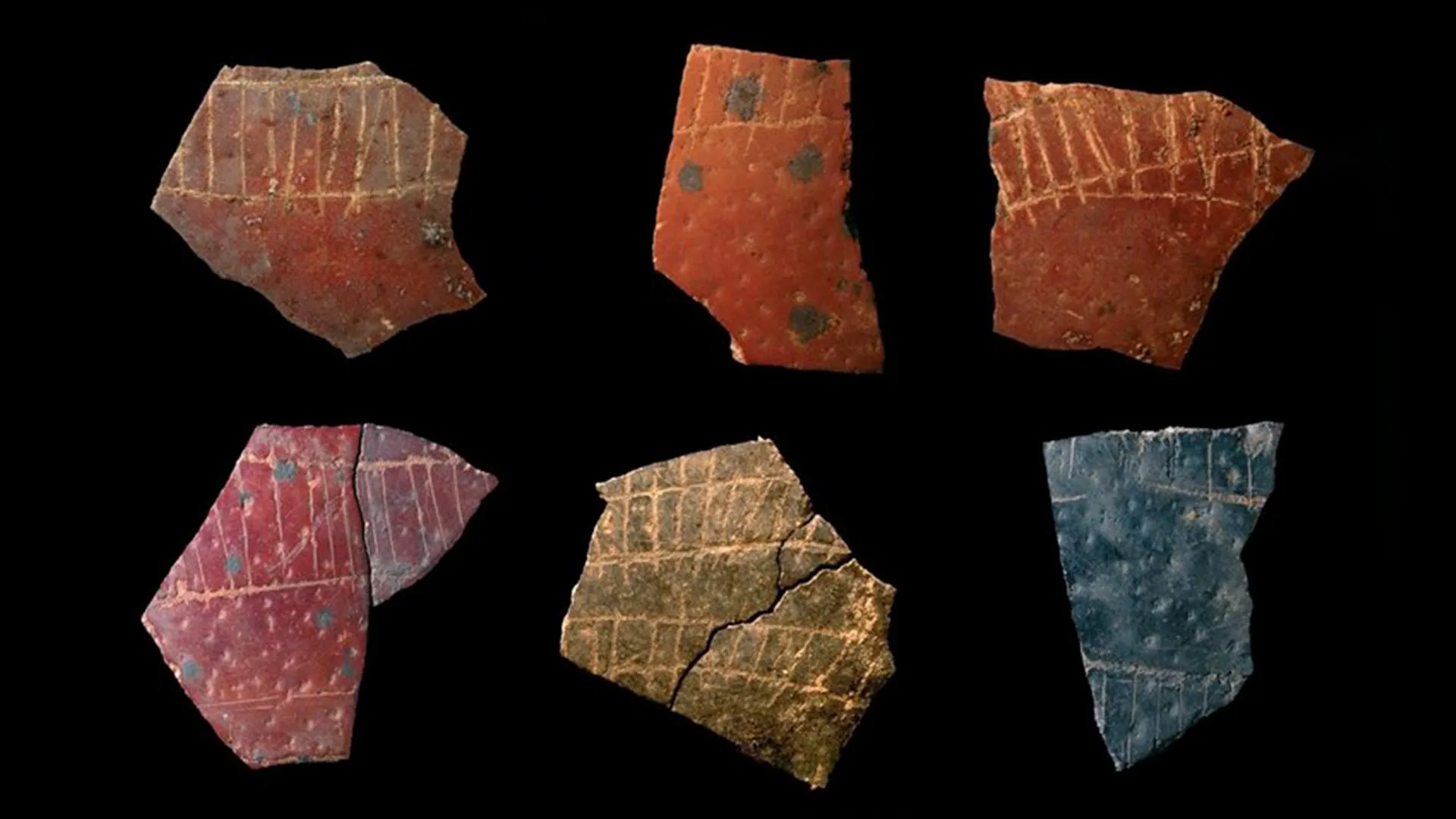
Far from being random scratches or idle doodles left by prehistoric hunter-gatherers, these delicate markings—recovered from renowned sites in South Africa and Namibia—demonstrate a sophisticated mastery of geometry, spatial planning, and symbolic abstraction. Published recently in the journal PLOS One under the title "Earliest Geometries. A Cognitive Investigation of Howiesons Poort Engraved Ostrich Eggshells," the study offers unprecedented insight into the minds of early Homo sapiens.
Using cutting-edge quantitative analyses that combine statistical modeling with geometric profiling, the research team decoded the structural logic underlying 112 fragments. The findings indicate that ancient artisans possessed an embryonic visual grammar, utilizing parallel lines, right angles, rotational symmetry, and hierarchical grid systems. This cognitive leap—the ability to conceptualize, plan, and execute complex spatial relationships on a curved surface—marks a foundational milestone in human evolution, bridging the gap between basic survival strategies and the birth of abstract symbolic thought.
Detailed Chronology: Unearthing the Artifacts of Howiesons Poort
The journey to decoding these ancient engravings spans decades of meticulous excavation across southern Africa, intersecting with one of the most culturally dynamic periods of the Middle Stone Age: the Howiesons Poort techno-complex.
The Archaeological Landscape: Diepkloof, Klipdrift, and Apollo 11
The artifacts at the center of the new study were unearthed across three primary archaeological locations renowned for preserving organic materials from deep prehistory:
- Diepkloof Rock Shelter (South Africa): Situated in the Western Cape, Diepkloof is globally celebrated for its rich layers of engraved ostrich eggshells, providing a continuous record of early symbolic behavior.
- Klipdrift Shelter (South Africa): Also located in the southern Cape, Klipdrift has yielded critical evidence regarding coastal resource exploitation and symbolic expression during the Middle Stone Age.
- Apollo 11 Cave (Namibia): Located in the Ha-Uib mountains of southern Namibia, this cave is famous for its painted stone slabs and extensive artifact assemblages, extending the geographic scope of the southern African engraving tradition.
During the Howiesons Poort period—roughly spanning 65,000 to 60,000 years ago—these sites served as home to resilient groups of Homo sapiens navigating a shifting African climate. Ostrich eggshells were prized commodities in these arid and semi-arid environments. Because a single egg could hold up to a liter and a half of water, they functioned as portable, life-saving canteens.
Once emptied, these durable containers were frequently transformed into canvases. Rather than discarding them, ancient makers incised them with deliberate, repetitive geometric motifs. For generations, archaeologists debated the purpose of these designs, often categorizing them broadly as decorative art or personal markers of ownership. However, the lack of a standardized analytical framework left their underlying structure poorly understood—until now.
The Breakthrough Methodology
To bridge this analytical gap, the University of Bologna research team—comprising Valentina Decembrini, Ludovica Ottaviano, Mattia Cartolano, Enza Elena Spinapolice, and Silvia Ferrara—pioneered a quantitative approach never before applied to these fragile prehistoric artifacts.
The team systematically examined 112 fragments, mapping every stroke, intersection, and curve. By employing advanced geometric and statistical techniques, the researchers reconstructed the exact trajectories, angles, and spatial paths of the engraved lines. This rigorous methodology allowed them to move beyond subjective interpretations of the art and evaluate the physical evidence through an objective, mathematical lens.
The results were definitive: more than 80% of the analyzed configurations adhered to rigid, consistent spatial patterns. The artisans were not carving freehand without a plan; they were executing complex designs governed by internal structural rules.
Supporting Context & Metrics: Decoding the Ancient Visual Grammar
The quantitative analysis of the Howiesons Poort eggshells yielded precise metrics that redefine our understanding of Middle Stone Age cognition. The data reveals that early Homo sapiens were operating with an intuitive, yet highly structured, geometric toolkit.
Key Metrics and Spatial Patterns
- 80+ percent: The proportion of analyzed fragments exhibiting consistent, rule-bound spatial patterns rather than random execution.
- Right-Angle Mastery: Angles clustering tightly around 90 degrees appeared repeatedly across disparate artifacts, indicating a formalized understanding of orthogonal relationships.
- Parallelism and Symmetry: Sets of strictly parallel lines, rotational symmetries, and translational repetitions dominated the assemblages, pointing to systematic spatial organization.
- Hierarchical Embedding: Advanced fragments displayed "embedding"—the sophisticated capacity to build hierarchical levels of signs within the same limited surface, such as drawing grids within hatched bands or nested diamond motifs.
From Decoration to Cognitive Architecture
To fully appreciate these metrics, one must consider the cognitive demands required to engrave a curved, fragile surface like an ostrich eggshell. Unlike flat stone or bark, a spherical eggshell presents continuous spatial distortion. To maintain parallel lines, calculate right angles, and execute complex geometric grids without modern drafting tools requires profound visuo-spatial planning.
The researchers emphasize that the engraving process demands a dual capability: the artisan must hold an overarching mental image of the final design before making the first incision, and they must possess the motor control and rule-based logic to execute it stroke by stroke.
This capacity to translate abstract mental templates into physical reality represents a crucial stepping stone in human cognitive evolution. It mirrors the foundational principles later required for cartography, architecture, and, ultimately, the development of formal writing systems.
Official Statements: Perspectives from the Research Team
The implications of the study extend far beyond archaeology, offering profound insights into the universal traits of human consciousness. The researchers behind the PLOS One publication have articulated the broader significance of their findings through detailed commentary.
Dr. Silvia Ferrara, Professor at the University of Bologna’s Department of Classical Philology and Italian Studies and coordinator of the study, underscores the structured nature of the findings:
"These signs reveal a surprisingly structured, geometric way of thinking. We are talking about people who did not simply draw lines, but organized them according to recurring principles—parallelisms, grids, rotations and systematic repetitions: a visual grammar in embryo."
Dr. Ferrara further highlights the intentionality behind the prehistoric craftsmanship:
"These engravings are organized and consistent, and show mastery of geometric relationships. There is not only a process of repeating signs: there is real visuo-spatial planning, as if the authors already had an overall image of the figure in mind before engraving it."
Echoing these insights, Valentina Decembrini, a PhD student at the University of Bologna and lead author of the study, places the discovery within the broader trajectory of human history:
"Our analysis shows that Homo sapiens 60,000 years ago already possessed a remarkable ability to organize visual space according to abstract principles. Transforming simple forms into complex systems by following defined rules is a deeply human trait that has characterized our history over millennia, from the creation of decorations to the development of symbolic systems and, ultimately, writing."
The research was conducted under the auspices of the FIS Advanced project SAPIENCE (Symbols, Preliteracy and Code Evolution), directed by Professor Ferrara in close collaboration with Professor Enza Spinapolice of the Sapienza University of Rome. This interdisciplinary initiative seeks to trace the evolutionary pathways that led humans from early symbolic markers to complex information-sharing systems.
Future Outlook: The Horizon of Cognitive Archaeology
As the academic community digests the findings published in PLOS One, the SAPIENCE project team is already looking toward the next horizon of research. The revelation that 60,000-year-old humans utilized an embryonic visual grammar opens up several vital avenues for future scientific inquiry.
Expanding the Geographical and Temporal Scope
One of the primary goals for upcoming research is to apply this quantitative geometric methodology to artifact assemblages outside of southern Africa. By examining engraved media from East Africa, North Africa, and early Eurasian sites, researchers hope to determine whether these geometric principles were part of a pan-African cognitive toolkit possessed by early modern humans before their major migrations across the globe, or if regional variations developed independently.
Investigating the Evolution of Symbolism
Future studies will also aim to decode the potential communicative functions of these patterns. While the current research focused primarily on the syntax—the structural rules governing how lines and shapes were arranged—the next challenge lies in exploring the semantics. Were these geometric arrays markers of specific social groups, clan lineages, territorial maps, or mnemonic devices for tracking seasonal resource availability?
Advanced micro-wear analysis, high-resolution 3D surface scanning, and cognitive modeling will play pivotal roles in answering these questions. Furthermore, comparative studies involving contemporary neurological research on how the human brain processes visual patterns will help bridge archaeology and cognitive science.
Redefining the Human Narrative
Ultimately, the study of these ancient ostrich eggshells forces a re-evaluation of our distant ancestors. For generations, popular historical narratives relegated Paleolithic humans to a purely utilitarian existence, defining progress almost exclusively through stone tool technology.
The work led by the University of Bologna demonstrates that long before the rise of urban civilizations, the invention of the printing press, or the codification of alphabets, the human mind was already driven by a fundamental urge to order the universe through geometry. In the delicate, incised lines of a water flask made from an eggshell, we catch our earliest glimpse of a mind reflecting upon itself—transforming the chaos of nature into the structured elegance of art and abstraction.