







Executive Overview
In the intricate theater of the natural world, communication has long been understood as a vital tool for survival within a single species—a way for wolf packs to coordinate hunts, birds to claim territory, or bees to map out floral resources. However, groundbreaking new research reveals that the evolutionary conversation extends far beyond biological boundaries. A comprehensive review published in the journal Animal Behaviour demonstrates that communication plays a fundamental, hitherto underappreciated role in orchestrating cooperative relationships between entirely different species.
Compiled by an unprecedented coalition of 58 international researchers spanning anthropology, biology, and linguistics, the study investigates how animals utilize auditory calls, complex body movements, visual displays, and chemical or vibrational signals to bridge the gap between diverse taxonomies. These cross-species exchanges allow animals to synchronize their behaviors, secure shared resources, navigate dangerous predatory landscapes, and maintain mutually beneficial partnerships that can span generations.
The implications of this study stretch far beyond behavioral ecology. By examining how animals as disparate as birds, fish, insects, and mammals negotiate cooperation—often when their sensory perceptions of the world differ wildly—scientists are gaining a revolutionary window into the origins and evolution of communication itself. From the greater honeyguide bird leading humans to hidden bee colonies in exchange for sweet wax, to cleaner fish advertising their parasite-removal services to formidable reef predators, the natural world operates on a complex, cross-species network of information sharing. This article explores the mechanics, risks, adaptability, and evolutionary pathways of this interspecies dialogue, drawing upon insights from the study’s lead architects to decode how nature’s cross-cultural communicators survive and thrive.
Detailed Chronology
The Genesis of a Global Collaboration: July 2023
The foundation for this landmark review was laid during an intensive interdisciplinary workshop held in Cambridge in July 2023. Recognizing that research on interspecies interactions was largely fragmented across specialized subfields—such as behavioral ecology, human-animal studies, and marine biology—organizers sought to bring together leading global minds to synthesize decades of disparate observations.
This gathering united experts studying diverse ecological systems: researchers analyzing wild bird-human mutualisms, marine biologists observing cleaner fish stations, entomologists tracking subterranean insect communications, and anthropologists examining human-animal working partnerships. The core objective of the workshop was to establish a unified framework for understanding how information flows across species boundaries and how these communicative bridges are built, maintained, and modified over evolutionary time.
Synthesis and Publication: Animal Behaviour
Following months of collaborative data synthesis, cross-referencing, and theoretical modeling, the multidisciplinary team formalized their findings into a comprehensive review. Published under the title "The ecology and evolution of cues and signals in animal interspecies cooperation," the paper features contributions from 58 authors. It marks a paradigm shift in how behavioral scientists view the animal kingdom, moving away from isolated single-species studies toward a holistic, ecosystem-wide perspective on communication networks.
Supporting Context & Metrics
To appreciate the scale and complexity of cross-species cooperation, one must examine the diverse tactical repertoires animals use to make themselves understood across biological divides.
Bridging Sensory Divides
For cooperation to succeed, interacting species must frequently synchronize the timing of their actions to achieve a shared objective. This coordination is exceptionally challenging when the participants perceive and interact with the environment through entirely different sensory modalities.
Consider the relationship between the greater honeyguide bird (Indicator indicator) and humans. The honeyguide possesses an innate ability to locate wild bee nests but lacks the tools to safely breach them. Humans possess the capability to harvest the nests using smoke and tools, but often lack the precise location data. Through a specialized, high-pitched chatter, the honeyguide attracts human attention, guides them to the hive, and actively listens and responds to human return calls, ensuring a successful collaborative extraction.
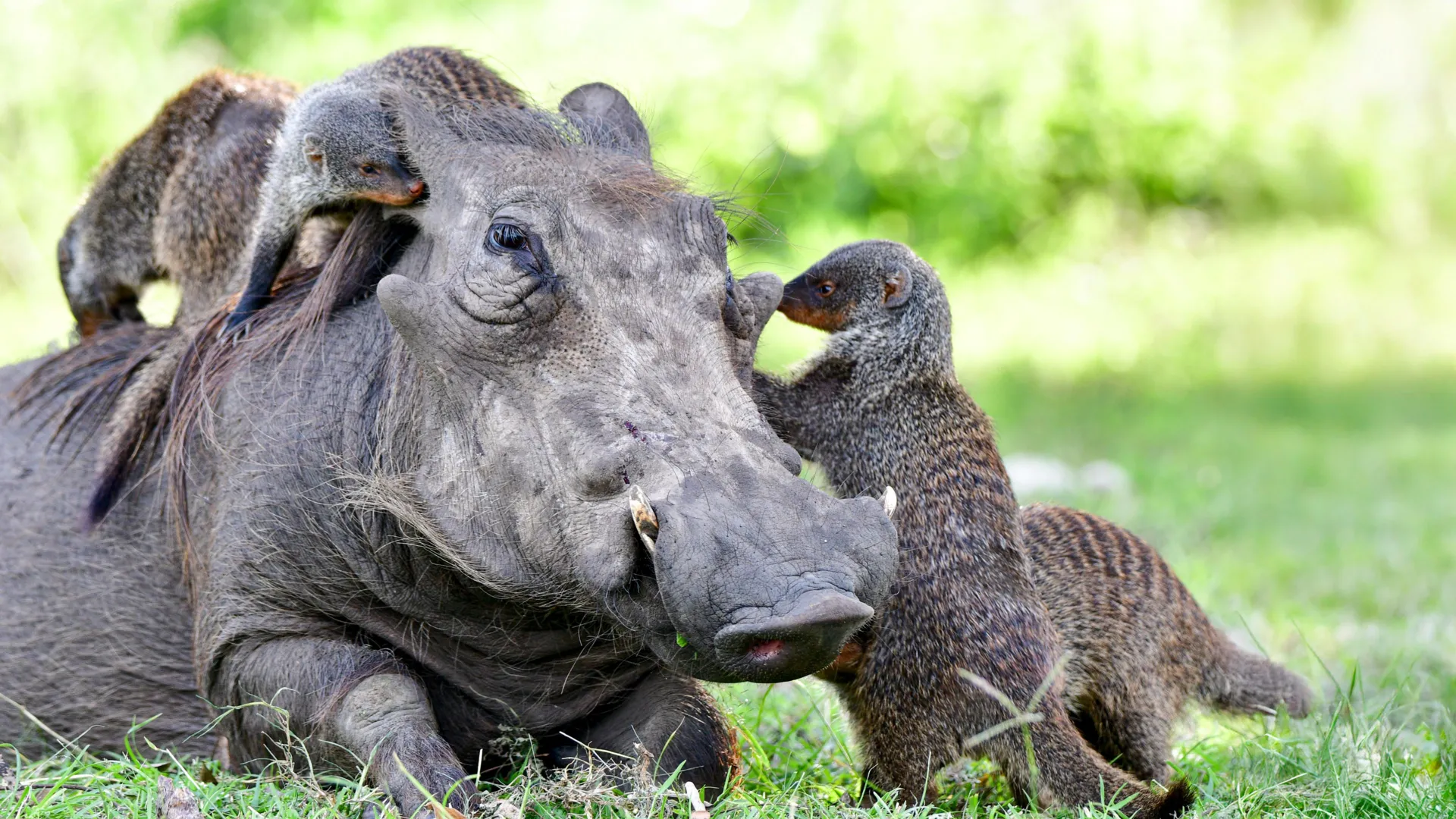
Similarly, warthogs seeking relief from biting parasites use distinct, highly ritualized body postures to signal vulnerability and invite cleaning services from sympatric birds and mongooses. These behavioral displays act as universal language passports, granting safe passage and service access across species lines.
Managing Risks and Establishing Trust
Interactions with unfamiliar species are inherently perilous. An animal approaching a potential partner runs the risk of exploitation, predation, or injury. Consequently, communication systems have evolved not merely to initiate contact, but to authenticate partners and mitigate biological risks.
- Visual Signaling in Marine Cleaners: Cleaner fish (Labroides dimidiatus) and specialized marine shrimp (Urocaridella sp.) utilize high-contrast, bright coloration patterns and rhythmic, undulating bodily movements. These visual cues broadcast their identity as benign service providers to predatory reef fish, effectively disarming the predator’s hunting instincts and permitting safe, close-range parasite removal.
- Chemical and Vibrational Deception: In the insect world, lycaenid butterfly larvae face immense danger from predatory ants. Rather than relying on sight, these larvae secrete complex chemical compounds and produce specific vibrational substrates that mimic the acoustic signals of ant brood. This sophisticated biochemical and vibrational communication tricks ants into adopting, protecting, and feeding the caterpillars rather than consuming them.
Signal Plasticity and Ecological Context
Communication systems governing interspecies cooperation are rarely rigid; instead, they exhibit remarkable flexibility depending on ecological variables, geographic location, and transmission pathways (whether inherited genetically or learned socially).
While marine fish seeking cleaning services tend to rely on highly conserved, predictable physical postures—such as vertical headstands or tail-stands—other systems are profoundly fluid. For example, artisanal fishermen cooperating with wild dolphins to catch fish read subtle, highly localized behavioral cues from the dolphins to determine the precise moment to cast their nets. These signaling repertoires vary significantly from one coastal region to another, demonstrating that animals and their human partners can invent, adapt, and culturally transmit cooperative codes.
Official Statements
The complexities of these cross-species dynamics have shed new light on evolutionary biology, prompting leading researchers to articulate the broader significance of their findings.
"From the examples we know, individuals coordinate their actions to access shared resources, like food, or to exchange resources for services, such as protection from predators. We were particularly interested in how sharing information allows such close coordination between species."
— Dr. Katie Dunkley, Lead Author, University of Oxford
Dr. Dunkley’s emphasis on resource access and service exchange underscores the economic nature of these partnerships. Natural selection favors communication systems that maximize net energetic gains while minimizing risk, driving the evolution of sophisticated signalling protocols.
"In some forms of interspecies cooperation, cues and signals vary depending on the ecological context, the species involved, and whether the signal is inherited or learned. This highlights just how flexible and adaptable interspecies communication can be."
— Dr. van der Wal, Senior Author, UCT’s FitzPatrick Institute of African Ornithology
Dr. van der Wal highlights the dual nature of these signals: some are hardwired genetic products of long-term coevolution, while others represent dynamic, learned behaviors capable of adapting to shifting environmental pressures.
Furthermore, addressing the evolutionary origins of these systems, Dr. Dunkley notes:
"Studying how information flows between species gives us a powerful window into how communication systems originate, change, and sometimes coevolve."
Researchers posit that many cooperative signals originate as "cues"—incidental traits or behaviors that happened to influence another animal’s behavior without originally evolving for communication. Over vast evolutionary timescales, natural selection refines these accidental cues into specialized, high-fidelity signals. Alternatively, behaviors originally selected for internal social functions, such as parental care or conflict resolution, are frequently co-opted and repurposed for interspecies negotiations.
Future Outlook
The publication of this comprehensive review in Animal Behaviour marks not a conclusion, but a foundational springboard for future scientific inquiry. The consortium of 58 researchers has charted a clear roadmap for the next generation of behavioral ecology.
Expanding Taxonomic Horizons
A primary limitation in current research is the historical bias toward studying charismatic or easily observable vertebrate systems—such as birds and mammals. The authors emphasize an urgent need for broader, more inclusive empirical studies encompassing neglected taxonomic groups, including invertebrates, amphibians, and deep-sea organisms. By widening the observational net, scientists anticipate discovering entirely novel modes of cross-species dialogue.
Experimental Innovations
Moving beyond observational naturalism, the scientific community must design rigorous field and laboratory experiments to test the causal mechanics of interspecies communication. Key questions remain regarding:
- How signals first arise within transitional ecosystems.
- The mechanisms that prevent cheaters from destabilizing cooperative networks.
- How anthropogenic environmental changes (such as noise pollution, habitat fragmentation, and climate shifts) disrupt delicate interspecies communication loops.
As research accelerates, the insights gained will not only deepen our theoretical understanding of evolutionary biology and behavioral linguistics, but also offer critical lessons in ecological conservation. Preserving biodiversity is increasingly viewed not merely as protecting isolated species in a vacuum, but as safeguarding the invisible, communicative threads that bind entire ecosystems together.
As Dr. van der Wal aptly concluded, "We still have much to learn about how these systems function and evolve. We look forward to future research revealing both these interactions and other forms of interspecies cooperation yet to be discovered."