










Executive Overview
Paleontological research has always relied on piecing together fragments of deep time, turning stone-bound puzzles into narratives of ancient life, dominance, and survival. A groundbreaking study published on July 15, 2026, in the open-access journal PLOS One offers a vivid glimpse into the brutal realities of the Late Cretaceous period. Led by researcher Bethania C. T. Siviero and her esteemed colleagues at Loma Linda University, the study details the meticulous analysis of fossilized dinosaur bones discovered in the rugged terrain of northeastern Wyoming.
Embedded within these ancient fragments are distinct dental signatures—depressions, punctures, holes, and grooves—that bear the unmistakable forensic hallmarks of the undisputed king of prehistoric predators: Tyrannosaurus rex.
The implications of this discovery extend far beyond the identification of a single prehistoric feeding event. By examining over 3,000 individual Cretaceous-era bones, Siviero’s research team has not only pinpointed rare evidence of apex predator interaction but has also established a much-needed diagnostic framework for differentiating true carnivore bite marks from geological, biological, and pathological mimicry.
In a field where weathering, insect burrowing, and bone disease can easily masquerade as predatory trauma, this newly minted interpretative guide provides paleontologists worldwide with a refined methodological tool. The findings illuminate the complex ecological webs of 72-to-66-million-year-old ecosystems, capturing moments of violent predation, scavenging, and the slow, relentless passage of deep geologic time.
Detailed Chronology and Methodological Investigation
The journey from a windswept Wyoming hillside to the pages of PLOS One represents years of painstaking fieldwork, meticulous microscopic and macroscopic examination, and rigorous anatomical comparison.
The Wyoming Bonebeds: A Window into the Late Cretaceous
The fossils at the heart of this study were unearthed from prolific late Cretaceous deposits in northeastern Wyoming, specifically targeting strata dating roughly 72 to 66 million years ago. This narrow temporal window captures the twilight of the non-avian dinosaurs, a geologically turbulent era just millions of years away from the catastrophic Chicxulub asteroid impact that would permanently redraw the map of Earth’s biodiversity.
The region during this epoch was a dynamic, lush landscape characterized by meandering river systems, expansive floodplains, and dense coastal vegetation. It was an environment capable of sustaining massive biomasses of megafauna, most notably Edmontosaurus annectens. Known colloquially as the duck-billed dinosaur, E. annectens was a heavy-bodied herbivore equipped with a broad, duck-like bill designed for stripping foliage. These animals roamed the ancient floodplains in herds, serving as the primary caloric engine for the region’s apex carnivores.
Sifting Through Thousands of Specimens
To capture a statistically meaningful sample of ecological interactions, Siviero and her team embarked on an exhaustive inventory of more than 3,000 individual fossilized bones recovered from the Wyoming site. Every single specimen underwent rigorous preliminary screening to catalog surface modifications, fractures, and structural anomalies.
Out of this massive collection of over 3,000 bones—the vast majority of which belonged to Edmontosaurus annectens—researchers isolated a mere subset of 12 specimens exhibiting trace modifications that immediately demanded closer scrutiny. These 12 bones bore suspicious depressions, punctures, and furrowed grooves indicative of direct mechanical impact from sharp, pointed objects.
The T. Rex Smoking Gun
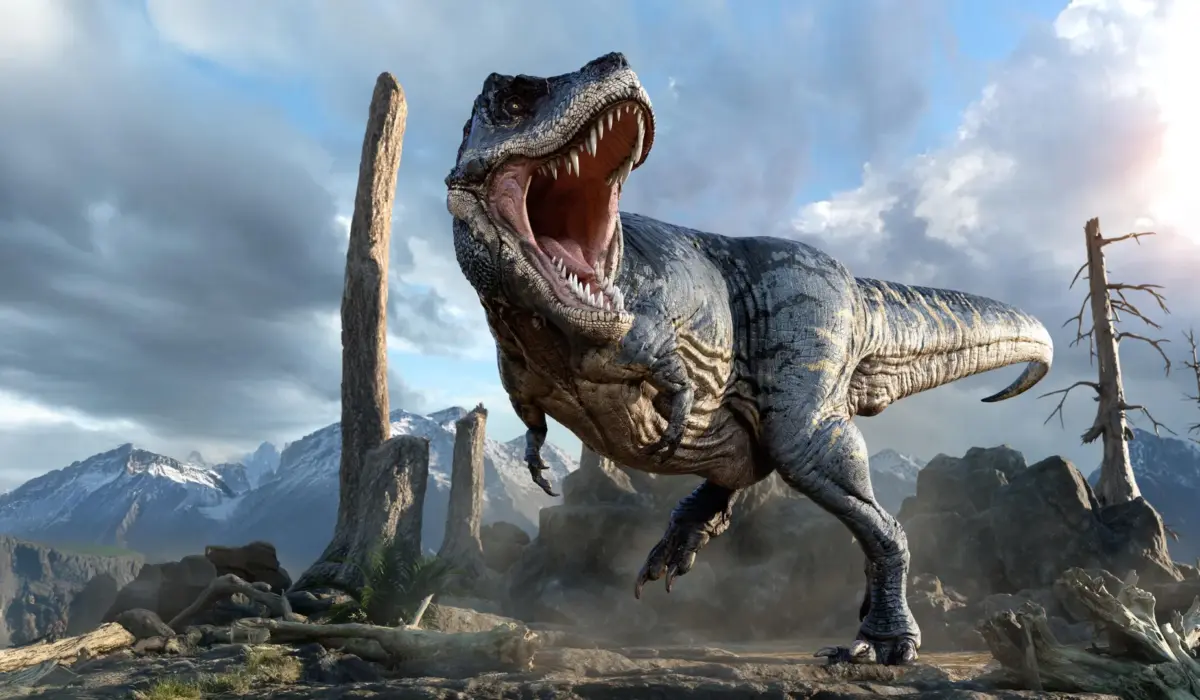
Through careful comparative anatomy, digital imaging, and dental morphology alignment, the research team isolated four bones featuring exceptionally distinctive surface patterns. The spacing, depth, angle, and curvature of the punctures and scoring matched the expected shape, size, and inter-tooth spacing of adult Tyrannosaurus rex dentition.
T. rex possessed a set of robust, D-shaped, serrated teeth engineered not for precision slicing, but for bone-crushing power. The marks found on these four specific fossil fragments—including notable neural spine fragments—aligned perfectly with the massive bite force and unique dental architecture of North America’s premier apex predator.
While T. rex was responsible for the most dramatic and structurally disruptive traces, the remaining eight marked bones presented a more diverse forensic profile. The subtle variations in width, depth, and striation patterns suggested that other secondary predators and opportunistic scavengers active in the Late Cretaceous ecosystem had also left their mark. These likely included smaller carnivorous theropods as well as large semiaquatic crocodilians that shared the ancient river systems with the dinosaurs.
Supporting Context and Metrics
To fully appreciate the significance of Siviero’s study, one must understand the quantitative landscape of trace fossil analysis—ichnology applied to vertebrate osteology—and the rigorous hurdles researchers must clear to validate their claims.
Quantitative Breakdown of the Study
- Publication Date: July 15, 2026
- Journal: PLOS One (Open Access)
- Lead Institution: Loma Linda University
- Lead Researcher: Bethania C. T. Siviero
- Geographic Location of Fossils: Northeastern Wyoming, USA
- Geological Age: Late Cretaceous (approx. 72 to 66 million years ago)
- Total Bones Examined: >3,000 specimens
- Primary Taxon Represented: Edmontosaurus annectens (duck-billed herbivore)
- Total Bones Exhibiting Tooth Traces: 12 specimens (0.4% of total examined)
- Bones with Definitive T. rex Patterns: 4 specimens
The Diagnostic Challenge: True Bites vs. Taphonomic Mimicry
One of the most valuable contributions of the new Loma Linda University study is its direct assault on a persistent methodological problem in paleontology: the misidentification of bone surface modifications.
When a bone is exposed to the elements for decades, centuries, or millennia before final burial, it undergoes a complex sequence of physical, chemical, and biological alterations collectively known as taphonomy. During this post-mortem phase, various non-predatory agents can inflict damage that closely mimics the punctures and furrows left by carnivorous teeth.
- Pathological Depressions: Diseases, bone cancers, localized infections, and developmental anomalies can cause bone resorption, thinning, or structural collapse, creating localized pitting that resembles healed or unhealed bite marks.
- Insect Bioerosion: Termites, dermestid beetles, and other ancient wood- or bone-boring insects frequently tunnel into or carve out shallow grooves and circular depressions on exposed carcasses, creating visual artifacts that can easily trick an untrained eye.
- Weathering and Root Etching: Acidic secretions from plant roots growing over buried bones can etch deep, winding grooves into the cortical bone. Furthermore, physical weathering cycles of freezing, thawing, shrinking, and swelling can fracture bone surfaces in patterns parallel to carnivore scoring.
- Transport Abrasion: As skeletal remains are tumbled downstream by energetic floodwaters, collision with abrasive pebble beds and gravel bars can gouge and puncture bone tissue.
By establishing strict geometric and morphological criteria to isolate genuine tooth marks from taphonomic noise, Siviero and her colleagues have fortified the empirical foundation of paleoichnology. Their newly developed identification guide equips future researchers with a systematic checklist to evaluate bone depressions and perforations with unprecedented precision.
Official Statements and Expert Insights
The research team emphasized the profound ecological implications of distinguishing between pre-mortem trauma, fatal predatory events, and post-mortem scavenging.
Reflecting on the complex nature of interpreting bone modifications, the authors stated in their published paper:
"Correctly identifying bone depressions and perforations is important because not all of these features are tooth marks. Some are caused by diseases, while others result from post-mortem processes such as insect activity or other processes due to bone exposure. Distinguishing between these different types of bone modifications is essential, as they can provide valuable information about an animal’s condition before death as well as the processes that affected its remains after death."
Furthermore, the researchers highlighted how these minute physical alterations serve as behavioral windows into lost worlds:
"The study of tooth marks on fossil bones is important because it provides valuable insights into animal behavior and interactions between species."
Feeding Dynamics: Predation Versus Opportunistic Scavenging
A critical takeaway from the distribution of the marks is the complete lack of bone healing surrounding the vast majority of the identified tooth traces. In living animals, bone tissue responds to traumatic injury—such as a crushing bite—by initiating an inflammatory and osteogenic healing response, leaving behind thickened, remodeled bone edges (calluses).
The absence of such healing indicators on the Wyoming fossils reveals that the bites occurred either at the absolute terminal moment of life (perimortem) or long after the animals had expired (post-mortem).
When synthesized with previous geological and paleontological data gathered from the same Wyoming site, a compelling behavioral narrative emerges. The prehistoric landscape was a high-stakes arena where Edmontosaurus annectens individuals were hunted down and killed by apex predators like Tyrannosaurus rex. Following the kill, or upon encountering a carcass that had died of natural causes, dominant carnivores stripped the primary flesh. As the skeletal remains remained exposed on the floodplain, a succession of secondary scavengers—ranging from lesser theropods to opportunistic crocodilians—moved in to chew on remaining nutrients, leaving their own distinct dental signatures before the entire assemblage was finally buried by sediment and preserved for millions of years.
Future Outlook: The Next Frontier in Paleoichnology
The publication of Siviero’s research in PLOS One marks a significant milestone, but it also signals the opening salvo in a broader methodological evolution within vertebrate paleontology. As analytical techniques grow more sophisticated, the study of fossilized trace marks is poised to transition from qualitative description to quantitative, high-resolution biomechanical modeling.
Technological Integration and Advanced Imaging
Future research endeavors are already looking toward non-destructive imaging technologies to push paleoichnology even further. High-resolution micro-computed tomography (micro-CT) scanning allows researchers to peer inside bone matrices beneath surface bite marks, mapping micro-fracture networks and internal stress lines that reveal the exact vector and magnitude of the bite force applied millions of years ago.
Additionally, three-dimensional photogrammetry and laser profilometry are enabling scientists to create exact digital twins of marked bones. These digital models can be shared instantly across global research networks, allowing comparative anatomists to test tooth-to-bone alignment against massive digital libraries of theropod dentition.
Broadening Geographic and Temporal Horizons
While the current study focused tightly on a specific Late Cretaceous deposit in northeastern Wyoming, the diagnostic framework developed by Loma Linda University researchers is universally applicable. Paleontologists working across diverse stratigraphic columns—from the Jurassic Morrison Formation to the Cretaceous Hell Creek Formation—can apply these standardized criteria to evaluate fossil collections worldwide.
By systematically re-evaluating museum drawers and archival bone collections using Siviero’s interpretive guide, the scientific community may uncover hidden evidence of predatory behaviors previously masked by taphonomic ambiguity.
Ultimately, this study underscores the reality that fossils are not merely static anatomical statues; they are dynamic archives of ancient violence, survival, and ecological recycling. As researchers continue to refine the tools used to read these stony records, the brutal yet magnificent realities of the Age of Dinosaurs will continue to come into sharper, more astonishing focus.