






Executive Overview
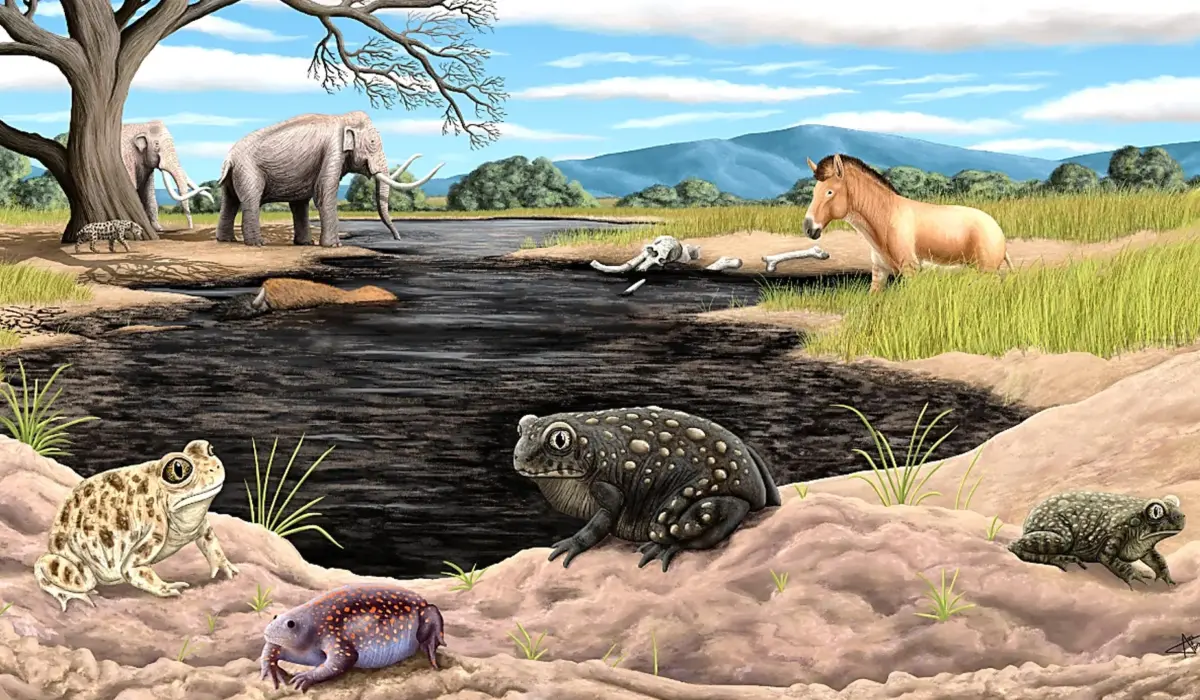
When the average person pictures the prehistoric landscape of Ice Age Los Angeles, the mind immediately conjures images of majestic Columbian mammoths, menacing saber-toothed cats (Smilator fatalis), and dire wolves locked in eternal struggles within the viscous, bubbling asphalt traps of the La Brea Tar Pits. For over a century, these charismatic megafauna have dominated public imagination and scientific inquiry alike, serving as the iconic poster children for North America’s late Pleistocene epoch.
However, a groundbreaking paleontological revelation has quietly shifted this paradigm downward—literally into the dirt. Researchers working at the world-famous fossil site have formally identified a previously unknown, extinct amphibian species that hopped through the prehistoric underbrush of Southern California some tens of thousands of years ago. Named Spea labreae, this newly discovered spadefoot toad represents a watershed moment in the history of the La Brea excavations: it is the first new extinct amphibian species ever officially described from the legendary asphalt deposits.
The discovery, recently detailed in the Journal of Vertebrate Paleontology, underscores a profound truth in modern paleontology: while massive bones capture headlines, tiny, fragile skeletons often hold the most sensitive keys to unlocking Earth’s climatic past. Amphibians are peerless environmental barometers. Because they possess permeable skin, complex life cycles tied strictly to localized freshwater sources, and limited migration ranges, they react acutely to shifting temperatures, precipitation patterns, and ecological fragmentation. Consequently, the identification of Spea labreae—alongside a shocking secondary discovery of a toad genus currently native to tropical Mexico—offers an unprecedented, high-resolution window into the drastic environmental upheavals that marked the twilight of the last Ice Age.
This remarkable breakthrough did not stem from a newly unearthed field jacket chiseled from a fresh asphalt pit, but rather from the meticulous re-examination of archives housed for over half a century within the museum’s legacy collections. As the institution undergoes a historic transformation spearheaded by the Samuel Oschin Global Center for Ice Age Research at La Brea Tar Pits, this discovery proves that museum basements remain as fertile ground for exploration as the active excavation sites outside their doors.
Detailed Chronology: Unearthing Spea labreae from the Archives
To trace the path of Spea labreae from an obscure, forgotten drawer of 1950s fossils to the pages of international scientific literature is to understand the modern ethos of archival paleontology. The discovery was led by Dr. Alberto Cruz, a paleoecologist and paleogeographer currently serving as a researcher for Mexico’s SECIHTI Centro de Investigación Paleontológica Quinametzin (CIPAQ) at the Instituto Nacional de Antropología e Historia (INAH).
Dr. Cruz’s journey began not with grand ambitions of discovering a lost species, but with the quiet, methodical labor of a postdoctoral fellowship at the La Brea Tar Pits. While his primary academic focus lay in ancient ecosystems and geographies rather than strict taxonomy, Dr. Cruz turned his attention to a largely understudied segment of the Tar Pits repository: the reptiles and amphibians.
For decades, the micro-fossils—including bones from lizards, snakes, frogs, and toads—had played second fiddle to the dramatic articulated skeletons of dire wolves and ground sloths. These delicate remains, preserved in miraculous three-dimensional clarity by the preserving properties of asphalt, had not received a comprehensive, modern systemic assessment in nearly thirty years.
As Dr. Cruz sorted through the collection, utilizing comparative osteology, he encountered a series of spadefoot toad elements displaying peculiar morphological anomalies. His initial hypothesis was medical rather than evolutionary: could these unusual skeletal configurations be the result of a pathology? Might these specific animals have suffered from skeletal diseases, developmental abnormalities, or severe injuries during their lifetimes?
Driven by scientific rigor, Dr. Cruz embarked on an exhaustive comparative campaign. He reviewed and re-reviewed scores of specimens, matching the fossilized elements against an extensive comparative library. To establish a baseline of anatomical variation, he personally examined approximately 80 modern amphibian specimens housed within the Herpetology Collections at the Natural History Museum of Los Angeles County (LACM) and the Museum of Vertebrate Zoology (MVZ) at the University of California, Berkeley.
As the data accumulated, the pathology hypothesis crumbled, replaced by an unmistakable realization. The structural differences in the bones—distinct variations in shape, crest development, and robusticity—were consistent, recurring, and entirely distinct from any known living or extinct spadefoot toad species.
"I reviewed and reviewed a lot of specimens until I was convinced," Dr. Cruz recalled. "I thought, ‘Oh my gosh, this is a new species.’ This material is originally from the 1950s, but when you study it again, you can find gold in these specimens. It’s very cool."
With the morphological distinctiveness of the bones established, the team formally erected the taxon Spea labreae, establishing a permanent taxonomic milestone for the iconic fossil locality and cementing the scientific value of looking backward through historical museum inventories.
Supporting Context & Metrics: Why Tiny Bones Matter More Than Mammoths
The discovery of Spea labreae is all the more exceptional when contextualized against the broader fossil record of North America. To date, S. labreae is only the second extinct Pleistocene amphibian species ever discovered and described across the entire North American continent—the sole other being an extinct tree frog species unearthed in the state of Florida.
The Fragility Paradox in the Fossil Record
Why are Pleistocene amphibian fossils so exceedingly rare? The answer lies in the physics of fossilization and the anatomy of the animals themselves. Frogs, toads, salamanders, and caecilians possess exceptionally lightweight, highly porous, and delicate skeletons. Under standard sedimentary deposition conditions—such as a normal riverbed or lake margin—these fragile bones are typically pulverized by currents, scavenged, or decomposed by microbial action long before mineral replacement can fossilize them.
Asphaltic deposits like those at La Brea represent a rare geochemical anomaly. Natural crude oil seeping to the surface created sticky, entrapment-heavy pools that ensnared everything from massive mammoths to insects and amphibians. The asphalt sealed these organic remains away from oxygen and destructive scavengers, resulting in pristine preservation.
Even within La Brea, however, small bones are easily overlooked during traditional, macro-scale excavations that prioritize large mammalian long bones and skulls. The preservation of Spea labreae serves as a testament to the complex taphonomic filters of the tar seeps. Furthermore, researchers like Dr. Cruz and his colleagues operate under the sobering assumption that Spea labreae is merely the tip of the iceberg; many other delicate amphibian and reptile species almost certainly lived, died, and vanished from the regional ecosystem without ever leaving a trace in the fossil record because their skeletons were simply too fragile to survive the fossilization process.
Amphibians as High-Resolution Climate Proxies
While a saber-toothed cat tells scientists a great deal about the availability of large prey and open woodlands, it is an imperfect indicator of micro-climatic shifts. Large mammals are mobile; they can migrate dozens or hundreds of miles to escape localized droughts, temperature spikes, or habitat fragmentation.
Amphibians operate under entirely different biological constraints. With very few exceptions:
- Limited Mobility: Most amphibians spend their entire lives within a restricted home range, rarely traveling more than a few hundred meters from their natal breeding ponds.
- Physiological Sensitivity: Their permeable skin makes them hyper-sensitive to ambient humidity, moisture levels, and temperature extremes.
- Aquatic Dependency: Their reproductive success is tied directly to the presence and duration of standing freshwater bodies.
These biological traits transform amphibians into invaluable "climate proxies." By charting the precise chronological appearance, disappearance, or morphological adaptation of species like Spea labreae, paleoclimatologists can reconstruct ancient local environments with a degree of spatial and temporal precision unattainable through mammalian studies alone.
If a specific lineage of spadefoot toads vanishes from the fossil stratum, or if structural shifts indicate physiological stress, researchers can infer local changes in seasonal rainfall, shifts in temperature regimes, and alterations in vegetative cover. In the case of Spea labreae, the toad’s presence helps fill critical gaps in our understanding of how southern California’s environment fluctuated as the Laurentide ice sheet retreated and global climates shifted at the close of the Pleistocene.
Official Statements & Institutional Perspectives
The unveiling of Spea labreae comes at a transformative time for the cultural and scientific institution that houses its bones. The discovery coincides with major ongoing capital and intellectual investments at the Samuel Oschin Global Center for Ice Age Research at La Brea Tar Pits, which is currently navigating a historic institutional evolution aimed at expanding its research capacity and public engagement.
Dr. Emily Lindsey, Curator and Excavation Site Director at the Samuel Oschin Global Center for Ice Age Research, emphasized the profound implications of the discovery for ongoing research paradigms.
"It’s a great example of how we’re still finding new things at La Brea Tar Pits, even after a century of ongoing excavation and research," Dr. Lindsey stated, highlighting the dual value of active fieldwork and archival stewardship. "There’s definitely more to come."
For Dr. Cruz, who balances his research affiliations between CIPAQ-INAH in Mexico and his ongoing role as a Research Associate at La Brea, the discovery highlights the interconnected nature of paleoecology across North America and the enduring utility of legacy collections.
"If you change the environment, you change the vegetation, the climate is warmer or colder, it affects these animals directly," Dr. Cruz noted, emphasizing the direct line of causation linking global climatic oscillations down to the individual survival and regional persistence of desert-adapted and temperate amphibians.
Expanding the Narrative: The Mexican Burrowing Toad Mystery
As if describing a brand-new extinct species from 1950s museum drawers were not enough of a scientific coup, Dr. Cruz’s exhaustive review of the La Brea micro-fossil collection yielded a second, entirely unexpected bombshell: the first verified fossil record of the Mexican burrowing toad, genus Rhinophrynus, in the southwestern United States.
To appreciate the magnitude of this discovery, one must look at a modern geographical map. Today, Mexican burrowing toads are strictly tropical and subtropical animals. Their closest living populations reside roughly 2,500 kilometers (more than 1,500 miles) away to the south in the warm, humid lowlands of southern Mexico and Central America. They are highly specialized, subterranean creatures that spend the vast majority of their lives buried underground, emerging only during torrential seasonal rains to breed in temporary pools.
Finding Rhinophrynus fossils embedded in the asphalt deposits of metropolitan Los Angeles shatters prior assumptions about the stability of regional biogeographic boundaries since the Pleistocene. It reveals that during certain intervals of the Ice Age, the climate and ecology of Southern California must have been dramatically different—capable of supporting tropical or subtropical elements that could never survive today’s Mediterranean climate regime.
This profound geographic shift, running in tandem with the evolutionary extinction of Spea labreae, adds vital complexity to the narrative of late Pleistocene environmental transition. The end of the Ice Age in North America was not a simple, linear warming trend, but a chaotic, highly dynamic reorganization of biotic communities. Habitats fragmented, climates oscillated rapidly between arid and wet phases, and species responded individualistically—some migrating thousands of miles, some adapting locally, and others, like Spea labreae, succumbing to extinction.
Future Outlook: Unlocking the Next Century of Tar Pits Science
The formal naming and description of Spea labreae in the Journal of Vertebrate Paleontology marks both a conclusion and a beginning. It concludes decades of relative anonymity for a collection of small, unassuming bones while opening an exciting new frontier for research into the non-mammalian inhabitants of the Ice Age world.
As the Samuel Oschin Global Center for Ice Age Research continues its historic institutional transformation, the focus of paleontology at La Brea is expanding outward. While the iconic dire wolves and mammoths will forever anchor the public’s fascination, the spotlight is increasingly shining on the micro-vertebrates, insects, plants, and pollen grains that together construct a holistic, ecosystem-wide portrait of prehistoric Los Angeles.
Implications for Modern Conservation Biology
Beyond historical curiosity, research into ancient amphibian extinction and migration carries urgent modern resonance. Earth is currently experiencing what many conservation biologists term the "Sixth Mass Extinction," driven primarily by anthropogenic climate change, habitat destruction, and emerging pathogens like the chytrid fungus that devastates global amphibian populations today.
Amphibians remain just as sensitive to environmental disruption now as they were tens of thousands of years ago. By studying how ancient species like Spea labreae and Rhinophrynus responded to rapid, natural climatic shifts at the close of the Pleistocene, modern scientists can glean critical predictive models. These historical case studies help conservationists understand how contemporary amphibian populations might react to shifting thermal baselines, desertification, and habitat fragmentation, providing empirical data to guide targeted conservation interventions.
Ultimately, Spea labreae stands as a powerful reminder that history is never fully written. Buried deep within dusty museum cabinets, cataloged decades ago by researchers who had no inkling of what they held, lay the physical proof of a lost species. As contemporary scientists apply modern analytical techniques to legacy collections, the La Brea Tar Pits continue to prove that even after more than a hundred years of relentless excavation, the asphaltic depths of Ice Age Los Angeles still hold countless secrets waiting to be brought to light.