








Executive Overview
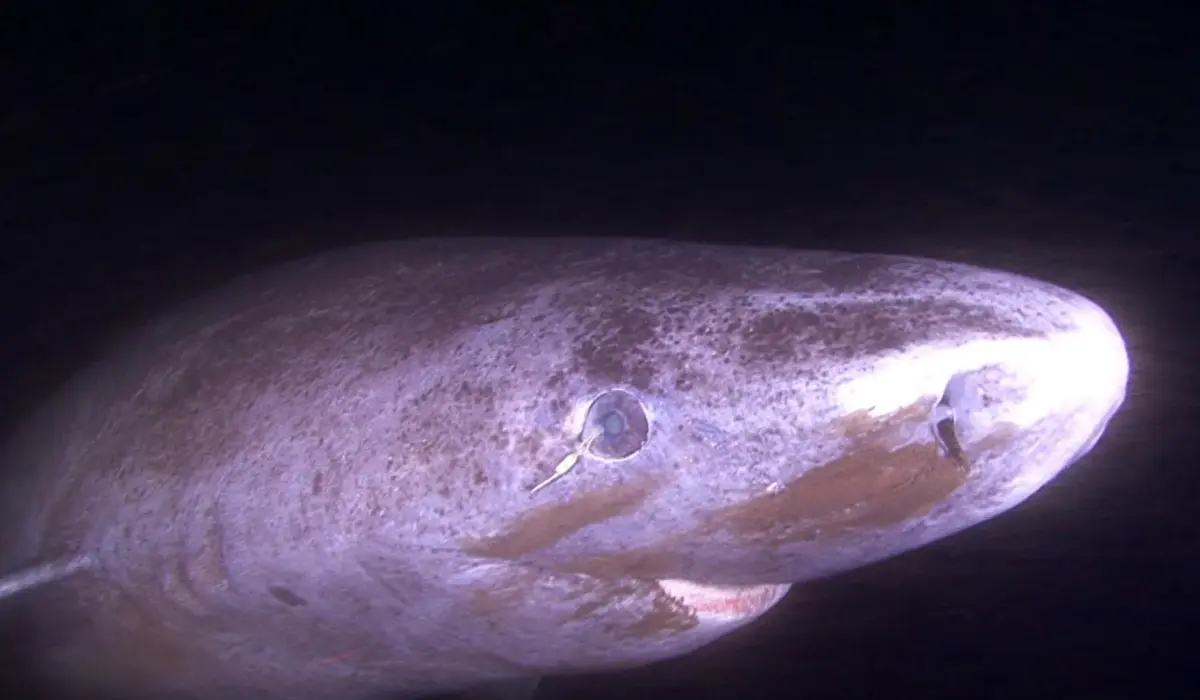
In the pitch-black, freezing depths of the Arctic Ocean, a silent leviathan glides effortlessly through the gloom. The Greenland shark (Somniosus microcephalus) is an evolutionary marvel, holding the crown as the longest-living vertebrate known to science, with individual lifespans stretching up to an astonishing 400 years. For decades, however, these mysterious creatures have presented a perplexing biological paradox.
Known for their thick gray bodies, small rounded snouts, and eerie, lifeless-looking eyes frequently infested with parasitic copepods, Greenland sharks were long written off by the scientific community as functionally blind. Given their murky, abyssal habitats and the physical trauma inflicted by these blinding ocular parasites, conventional evolutionary theory suggested that their visual systems should have degenerated long ago. After all, why maintain a complex organ in a realm devoid of light and plagued by parasites?
A groundbreaking study published in Nature Communications completely shatters this assumption. Led by Dr. Dorota Skowronska-Krawczyk, an associate professor of physiology and biophysics at the University of California, Irvine, an international team of researchers has discovered that Greenland sharks possess a sophisticated, highly resilient visual system. Far from being blind, these centuries-old predators feature retinas that show zero signs of age-related degeneration. Armed with robust DNA repair mechanisms and specialized proteins fine-tuned for deep-sea luminescence, the Greenland shark’s eye is a masterclass in biological longevity.
Beyond upending marine biology dogma, this discovery offers profound implications for human medicine. By understanding how the Greenland shark maintains pristine cellular function over four centuries without succumbing to retinal decay, researchers hope to unlock novel therapeutic pathways for combatting age-related vision loss, glaucoma, and macular degeneration in humans. This report provides an in-depth examination of the research, the arduous journey of analyzing centuries-old tissue, and the future outlook for longevity science.
Detailed Chronology: From a Spark of Curiosity to a Breakthrough in Nature Communications
The Genesis of an Investigation (2016–2020)
The genesis of this scientific milestone traces back to a 2016 landmark research paper published in the journal Science by marine biologist John Fleng Steffensen. The paper calculated the remarkable lifespan of the Greenland shark using radiocarbon dating of eye lens nuclei, confirming that these animals can live for centuries.
For Dr. Skowronska-Krawczyk, whose primary laboratory focus at UC Irvine centers on the molecular processes of age-related eye diseases, Steffensen’s paper was a lightning rod.
"One of my takeaway conclusions from the Science paper was that many Greenland sharks have parasites attached to their eyes—which could impair their vision," Skowronska-Krawczyk recalls. However, a deeper look disrupted her initial assumptions. "Evolutionarily speaking, you don’t keep the organ that you don’t need. After watching many videos, I realized this animal is moving its eyeball toward the light."
That singular observation—watching a creature of the abyss actively track a light source on a monitor—ignited a cross-disciplinary collaboration. Skowronska-Krawczyk teamed up with evolutionary biologists Walter Salzburger and Lily G. Fogg from the University of Basel in Switzerland to explore the evolutionary trajectory of the Greenland shark’s visual apparatus.
Fieldwork and Specimen Acquisition (2020–2024)
Securing samples of an elusive, deep-dwelling Arctic vertebrate is no small feat. Between 2020 and 2024, a team of field researchers—including Steffensen, Peter G. Bushnell of Indiana University South Bend, and Richard W. Brill of the Virginia Institute of Marine Science—embarked on expeditions near the University of Copenhagen’s Arctic Station on Disko Island, Greenland. Utilizing scientific longlines, the team successfully captured specimens, carefully dissected their eyes, and preserved the tissues in specialized fixative solutions to halt cellular degradation before shipping them to partner laboratories.
The UC Irvine Lab: Unpacking a 200-Year-Old Eyeball
The arrival of the specimens at UC Irvine marked a surreal moment for the research team. Emily Tom, a 28-year-old Ph.D. student and physician-scientist in training under Skowronska-Krawczyk, vividly remembers handling the biological package.
"I opened the package, and there was a giant, 200-year-old eyeball sitting on dry ice just staring back at me," Tom says with a laugh. "We’re used to working with mouse eyeballs, which are the size of a papaya seed, so we had to figure out how to scale up to a baseball-sized eyeball."
Managing the tissue demanded intense laboratory precision. The oversized ocular organs had to be defrosted meticulously. If the tissue warmed too quickly and reached ambient room temperature, the delicate cellular structures would rapidly deteriorate, ruining years of collaborative fieldwork.
"The lab smelled like a fish market," Tom notes.
Once thawed, Tom performed exhaustive histological and vision-specific analyses. To the astonishment of the team, microscopic examination of the retinal tissue revealed a complete absence of cell death (apoptosis), a hallmark of aging typically seen in vertebrate eyes. Furthermore, biochemical assays confirmed that rhodopsin—a crucial photoreceptor protein responsible for capturing light in dim environments—remained active and fully functional. The protein was specifically tuned to absorb blue wavelengths of light, matching the precise optical physics of the faint, bioluminescent or filtered solar rays penetrating the deep Arctic waters.
Supporting Context & Metrics
To fully appreciate the magnitude of this discovery, it is essential to contextualize the biology of the Greenland shark and the mechanics of vertebrate vision decay.
- Maximum Lifespan: Up to 400 years, making them the longest-lived vertebrate species known to modern science.
- Habitat Depth: Frequently found roaming at depths exceeding 2,000 meters (6,500 feet) in water temperatures hovering near freezing (-1°C to 10°C).
- Ocular Parasites: The copepod Ommatokoita elongata commonly attaches itself to the corneas of Greenland sharks, often causing severe corneal damage. Despite this, the new research proves the underlying retinal tissue remains preserved.
- Cellular Resilience: Unlike humans and most mammals, whose retinas suffer progressive oxidative stress, mitochondrial dysfunction, and cell death over decades, Greenland sharks exhibit extraordinary molecular stability, pointing to advanced DNA repair mechanisms.
- Visual Specialization: Rhodopsin extracted from the sharks’ retinas demonstrated a hyper-efficient adaptation to blue-spectrum light, proving that vision remains an active sensory modality for navigation and survival even in near-total darkness.
Official Statements and Perspectives
The collaborative nature of this breakthrough brought together experts from diverse fields—ranging from marine biology and field ecology to molecular physiology and medicine.
Dr. Skowronska-Krawczyk emphasizes the unique thrill of pioneering research in an underfunded niche:
"What I love about my work is that we are the first in the world to see results—at the forefront, finding new mechanisms, rules and discoveries," Skowronska-Krawczyk says, reflecting on her computer screen displaying the gliding Arctic shark. "Then, being able to share this joy with students—that’s the best part of it."
Emily Tom highlights the scarcity of neuro-ophthalmological research dedicated to non-model marine organisms:
"Not a lot of people are working on sharks, especially shark vision," Tom states. "We can learn so much about vision and longevity from long-lived species like the Greenland shark, so having the funds to do research like this is very important."
Co-authors Walter Salzburger and Lily G. Fogg of the University of Basel noted that the evolutionary pressures shaping the Greenland shark genome have yielded defensive phenotypes against senescence that modern biomedicine is only beginning to conceptualize. By tracing how genetic pathways protect ocular tissues across centuries of environmental stress, evolutionary biology is directly informing cellular gerontology.
Future Outlook: Translating Arctic Biology into Human Medicine
The implications of uncovering how Greenland sharks maintain pristine retinal integrity for 400 years extend far beyond marine biology. As global populations age, chronic ocular conditions such as age-related macular degeneration (AMD), diabetic retinopathy, and glaucoma continue to blind millions worldwide. These diseases are fundamentally tied to cellular aging, oxidative stress, and the gradual breakdown of retinal cells.
If researchers can isolate the exact molecular mechanisms—be it specialized DNA repair enzymes, unique chaperone proteins, or metabolic buffers—that shield the Greenland shark from retinal degeneration, these pathways could theoretically be harnessed or mimicked in human therapies.
However, realizing this translational potential requires sustained, long-term investment in basic science. Dr. Skowronska-Krawczyk acknowledges that shifting political landscapes and fluctuating federal research funding create uncertainties for exploratory, unconventional projects like shark vision research. Yet, her optimism remains resolute: "We will prevail."
Ultimately, the Greenland shark serves as a living library of biological longevity. As scientists continue to sequence genomes, analyze preserved tissues, and decode the evolutionary secrets of the Arctic’s oldest inhabitants, the dark waters of the north may hold the key to shedding light on human aging. What began as a curious observation of an eye tracking a pixelated light source on a computer monitor has opened a monumental new frontier in our quest to preserve human vision across the span of time.