









Executive Overview
Long after the control rods drop, the heavy machinery of a nuclear reactor goes quiet, and the deafening roar of fission ceases, a quiet, invisible transformation continues deep within the heart of the core. Even in a state of absolute operational shutdown, atomic remnants keep decaying. Months and years pass as long-lived radioactive fission products methodically burn through their remaining energy, releasing an imperceptible, continuous stream of subatomic particles known as antineutrinos.
For the first time in the history of particle physics, researchers have successfully captured and measured this lingering, ghostly antineutrino emission from a powered-down reactor. Spearheaded by the international Double Chooz collaboration—with key leadership from physicists Anthony Onillon and Thierry Lasserre of the Max-Planck-Institut für Kernphysik (MPIK) in Heidelberg, Germany—this milestone achievement has recently been published in the prestigious journal Physical Review Letters.
The implications of this breakthrough stretch far beyond fundamental physics. By proving that sensitive detectors can capture a readable antineutrino signature from a dormant reactor, the Double Chooz team has unlocked an entirely new paradigm for nuclear safeguards, international monitoring, and reactor safety. Where traditional monitoring relied on physical inspections, seals, and declared fuel logs—all of which are vulnerable to tampering or restricted access—antineutrino detection offers a non-intrusive, un-blockable, and continuous method to peer inside a reactor core from afar.
This deep-dive report explores the mechanics of the discovery, the technical hurdles overcome by the collaboration, the validation against complex nuclear models, and the broad geopolitical and industrial future of reactor monitoring in the nuclear age.
Detailed Chronology: Capturing the Ghost Particle
The journey to measuring post-shutdown antineutrinos spans decades of detector development, precision engineering, and meticulous data analysis. While neutrinos and their antimatter counterparts have been studied since the mid-20th century, capturing the weak, fading "afterglow" of a dormant reactor required pushing experimental particle physics to its absolute limits.
The Chooz Laboratory and the Detector Architecture
The ground-breaking measurement took place at the Chooz nuclear power facility, nestled in a wooded valley in northern France. Deep underground, sheltered from the torrential downpour of cosmic rays that constantly bombard the Earth’s surface, sits the Double Chooz detector. Positioned approximately 400 meters away from the facility’s two active reactor cores, this subterranean laboratory provides the ideal ultra-low-background environment required to spot the rarest of subatomic interactions.
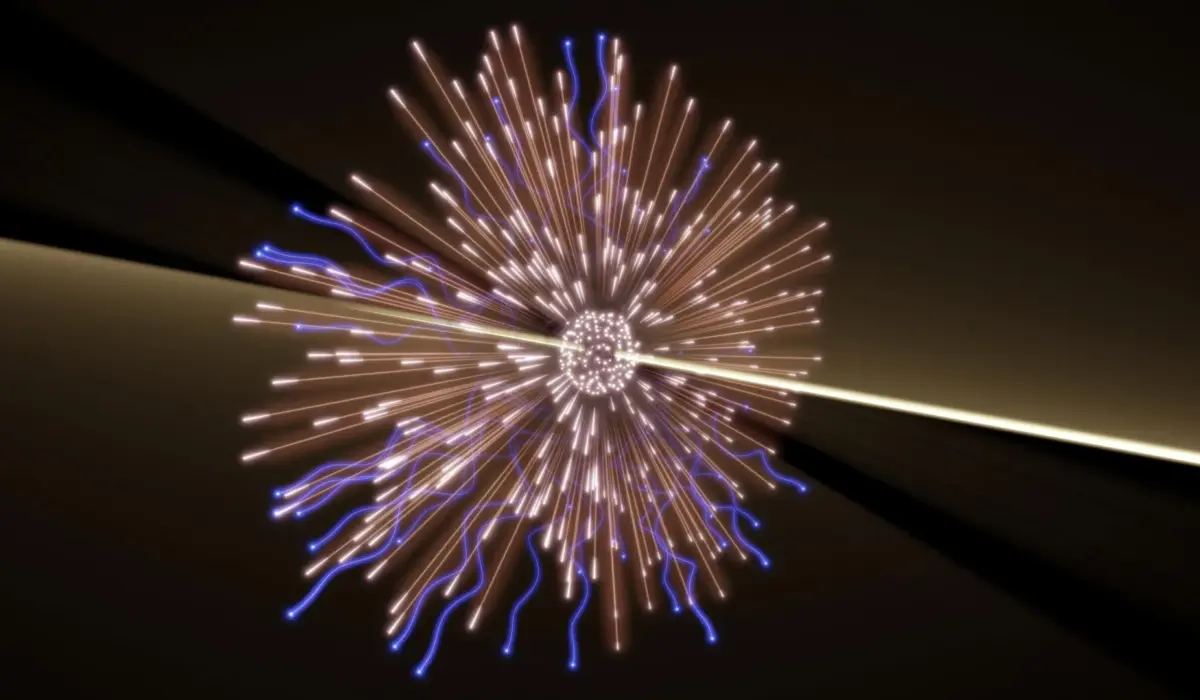
At the heart of the Double Chooz setup lies a cylindrical acrylic vessel filled with more than 30 cubic meters of liquid scintillator—a specialized, highly transparent organic liquid infused with chemical fluors. When an antineutrino occasionally interacts with a proton inside this liquid, it triggers a delicate sequence of events known as inverse beta decay. This reaction produces a positron and a neutron, creating a distinct, synchronized "double-light" signature: a prompt flash from the positron’s annihilation, followed closely by a delayed flash as the neutron is captured by a gadolinium nucleus.
Unmasking the Void: The 17.2-Day Shutdown Window
Normally, nuclear reactors produce an astronomical flux of antineutrinos, making operational reactors loud, bright beacons in the subatomic spectrum. The challenge for the Double Chooz team was entirely inverted: they had to hunt for a whisper in an empty room.
The collaboration focused their computational and analytical might on a very specific, highly prized dataset: a 17.2-day window of continuous observation gathered precisely when both reactor units at the Chooz facility were completely shut down for refueling and maintenance. During this period, the immense artificial antineutrino source vanished, leaving behind only the residual radioactivity trapped within the silent reactor cores and the adjacent spent-fuel cooling pools.
Combing through the background noise, the collaboration isolated approximately 100 antineutrino candidate events. These weren’t stray cosmic rays or electronic glitches; they were authentic antineutrinos generated by the slow, relentless decay of long-lived fission fragments—such as isotopes of cesium, strontium, and ruthenium—that remain bound within the spent fuel assemblies long after the chain reaction has stopped.
Supporting Context & Metrics: The Physics of the Invisible
To truly appreciate the magnitude of the Double Chooz collaboration’s achievement, one must examine the properties of antineutrinos, the nature of nuclear waste, and the razor-thin margins of error involved in the experiment.
The Elusive Nature of Antineutrinos
Antineutrinos are members of the lepton family and rank among the lightest, most elusive particles in the Universe. Because they possess no electrical charge and interact exclusively via the weak nuclear force and gravity, they care virtually nothing for ordinary matter. Billions of solar and reactor antineutrinos pass through the human body every second without leaving a trace. A light-year of solid lead would be insufficient to stop even half of a beam of high-energy neutrinos.
This extreme indifference to matter is precisely what makes them both frustrating to study and profoundly valuable for surveillance. While gamma rays and neutrons emitted by radioactive materials can be blocked by thick concrete and lead shielding, antineutrinos pass right through structural walls, steel containment vessels, and mountain ranges without attenuation.
Breakdown of the Post-Shutdown Signal
When a nuclear reactor operates at full power, fissions occur at a staggering rate, splitting uranium and plutonium atoms into various fission products. Many of these daughter nuclei are unstable and immediately decay, emitting antineutrinos.
When the reactor shuts down, the short-lived isotopes decay away within hours or days, causing the overall antineutrino flux to drop precipitously. However, a significant fraction of the fission products have half-lives lasting weeks, months, or years. The cumulative decay of these long-lived isotopes creates a stable, persistent baseline antineutrino emission.
| Parameter | Operational Reactor State | Post-Shutdown Reactor State |
|---|---|---|
| Primary Source | Active fission (U-235, Pu-239, Pu-241) | Decay of long-lived fission products & spent fuel |
| Antineutrino Flux | Extremely high (millions of interactions/day) | Extremely low (~100 candidate events over 17 days) |
| Signal-to-Noise Ratio | Favorable; easily distinguished from background | Highly challenging; requires ultra-low backgrounds |
| Primary Utility | Power monitoring, fuel burn-up tracking | Core status verification, spent-fuel auditing |
Validating Theoretical Models
The captured data did not merely prove that post-shutdown antineutrinos exist; it aligned with striking precision against advanced theoretical simulations. Researchers had previously modeled the expected inventory of nuclear fuel and the decay chains of lingering fission products. The Double Chooz dataset provided the world’s first direct experimental confirmation of these predictive models.
By confirming that real-world measurements match theoretical calculations for shut-down reactors, the scientific community now possesses a validated baseline. This foundational data paves the way for upcoming experiments—such as the Jiangmen Underground Neutrino Observatory’s Taishan Antineutrino Observatory (JUNO-TAO)—to refine our understanding of reactor physics and spent-fuel composition.
Official Statements & Expert Insights
The successful measurement has drawn widespread acclaim from the international particle physics and nuclear safeguards communities. Leaders of the Double Chooz collaboration have highlighted the rigorous methodology required to achieve this scientific milestone.
"Until now, reactor antineutrino experiments have mainly focused on operating reactors, where the antineutrino flux is much larger," notes Dr. Anthony Onillon, co-lead of the research from the Max-Planck-Institut für Kernphysik (MPIK). "Detecting the tiny residual signal after shutdown required exceptionally low backgrounds and careful analysis techniques developed by the Double Chooz collaboration over many years."
The transition from studying active cores to sensing the dormant embers of a reactor required a fundamental shift in how background interference is handled. Thierry Lasserre, representing the independent research group OMINA and also based at MPIK, elaborates on the mechanics of detection:
"Antineutrinos interact only extremely rarely with matter. However, when one interacts within the Double-Chooz detector, a characteristic double-light signal is produced that can be distinguished from background events," explains Lasserre. This distinctive electronic footprint is what allowed the team to separate authentic reactor antineutrinos from environmental radioactivity and cosmic muon spallation.
The implications for international scientific cooperation are equally vast. Presentations at major academic forums, including the Neutrino 2026 conference, indicate that global research groups are rapidly adopting these techniques. The validation provided by Double Chooz serves as a cornerstone, transforming what was once theoretical speculation into a practical, verifiable measurement protocol.
Future Outlook: A New Frontier for Nuclear Safeguards and Security
While the Double Chooz experiment was originally designed to investigate fundamental neutrino oscillations—specifically measuring the neutrino mixing angle $theta_13$, a crucial parameter explaining how neutrinos morph between different "flavors" as they travel—its final act has redefined its legacy. By bridging fundamental particle physics and practical nuclear engineering, the collaboration has opened up transformative applications.
Revolutionizing Nuclear Non-Proliferation and Safeguards
The International Atomic Energy Agency (IAEA) and national nuclear regulatory bodies face a perpetual challenge: verifying that declared nuclear material is not being diverted for unauthorized uses, and confirming that shutdown reactors are truly inactive. Traditional safeguards rely on physical seals, video surveillance, and paper audits. While effective, these methods can be circumvented, spoofed, or subjected to political obstruction.
Antineutrino detectors introduce an unforgeable, physics-based layer of transparency. Because antineutrinos cannot be shielded, blocked, or faked, an automated detector placed near a facility can independently verify:
- Whether a reactor is genuinely operating at full capacity or simply idling.
- The exact timing of reactor shutdowns and startups.
- The isotopic composition and mass of spent nuclear fuel stored in cooling pools.
Such a system could operate continuously and autonomously, transmitting encrypted data to international inspectors without requiring physical access to sensitive zones within a power plant.
The Road Ahead: JUNO-TAO and Beyond
As the Double Chooz experiment concludes its historic run, the torch has been passed to next-generation facilities. Projects like JUNO-TAO are already leveraging reactor-off data to refine our understanding of spent fuel signatures. With larger detector volumes, superior energy resolution, and advanced scintillation materials, future detectors will dramatically shorten the observation time required to spot a shutdown core—moving from weeks down to hours or even minutes.
Furthermore, these detectors could eventually assist in commercial spent-fuel management, helping plant operators audit fuel inventories and monitor the thermal and radioactive decay of waste assemblies with unprecedented precision.
Conclusion
The detection of the faint antineutrino glow from a dark, dormant reactor marks a triumph of human ingenuity. It demonstrates that even when macroscopic machinery falls silent, the subatomic universe continues to whisper its secrets. Through the persistence of the Double Chooz collaboration, physics has turned these faint whispers into a powerful new lens through which we can monitor, secure, and understand the complex world of nuclear energy.