








Executive Overview
For generations, the foundational dogma of paleontology and molecular biology was absolute: the process of fossilization is a grand eraser. Traditional scientific consensus maintained that over the span of millions of years, fragile organic molecules—such as proteins, DNA, and other complex biological building blocks—inevitably degrade, leaving behind only mineralized impressions and stone-cast shapes. According to this long-standing view, the notion of recovering original soft tissue or endogenous biomolecules from creatures that roamed the Earth during the Mesozoic Era was relegated to the realm of science fiction.
That paradigm is now officially shifting.
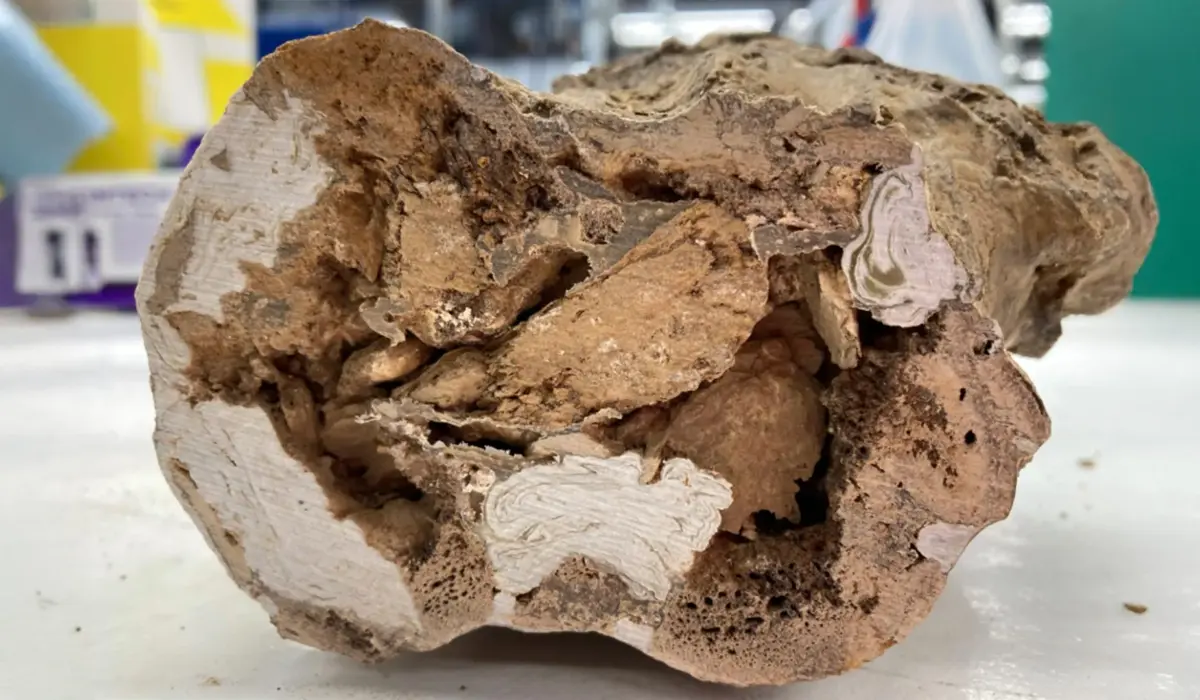
In a landmark study published in the journal Analytical Chemistry, an international, multidisciplinary team led by researchers at the University of Liverpool has delivered compelling, robust evidence that original organic materials can indeed survive the deep expanse of geological time. Focusing on an exceptionally well-preserved 22-kilogram sacrum (lower spine vertebrae connected to the pelvis) of an Edmontosaurus—a duck-billed dinosaur excavated from the fossil-rich Hell Creek Formation of South Dakota—scientists successfully detected and verified the presence of remnant collagen.
This breakthrough does more than just validate a controversial hypothesis; it strikes a definitive blow against the decades-old assumption that any organic remnants found in ancient fossils are merely modern microbial or environmental contaminants. Utilizing advanced analytical techniques, including high-resolution mass spectrometry and tandem mass spectrometry (performed in collaboration with researchers at UCLA and Liverpool’s own Materials Innovation Factory and Centre for Proteome Research), the team identified specific molecular signatures and amino acids unique to bone collagen, such as hydroxyproline, alongside fragments of collagen alpha-1.
The implications of this discovery are profound. By proving that endogenous proteins can endure for tens of millions of years, the research not only settles a fierce, 30-year scientific debate but also provides a roadmap for future investigations. It suggests that a century’s worth of archival cross-polarized light microscopy images of fossil bones could hold the keys to identifying thousands of other promising candidates. Ultimately, this opens an entirely new molecular frontier in paleontology, promising to refine evolutionary trees, clarify species relationships, and reveal biological insights long thought to be lost to history.
Detailed Chronology: Unlocking the Secrets of the Hell Creek Edmontosaurus
To understand the magnitude of this recent discovery, one must trace the convergence of exceptional geological preservation, cutting-edge analytical technology, and persistent scientific inquiry.
The Specimen and Its Provenance
The journey of this discovery began millions of years ago in what is now the Hell Creek Formation of South Dakota. Spanning parts of Montana, North Dakota, and Wyoming, the Hell Creek geological layer is globally renowned for preserving a breathtaking snapshot of life right at the Cretaceous-Paleogene boundary—the very twilight of the dinosaur age.
Buried within these Upper Cretaceous rock layers, the sacrum of an Edmontosaurus—a large, herbivorous duck-billed dinosaur—lay sheltered from the typical destructive chemical and geological forces that plague many fossil beds. Weighing 22 kilograms, this specific skeletal element was exceptionally well-preserved. Eventually unearthed and integrated into the scientific collections of the University of Liverpool, the bone offered an uncommonly pristine canvas for modern biochemical interrogation.
The 30-Year Scientific Battleground
The debate surrounding ancient proteins is not new. For roughly three decades, paleoproteomics has been a fiercely contested field. When pioneering researchers first reported finding soft tissues and putative protein remnants in dinosaur bones in the 1990s and 2000s, the scientific community met the claims with deep skepticism.
The primary critique—and the most formidable hurdle for researchers to overcome—was the specter of contamination. Skeptics argued with logical rigor that any organic compounds extracted from dinosaur fossils must be modern interlopers. They proposed that modern microbes, fungal hyphae, soil humic acids, human handling during excavation and museum curation, or laboratory reagents were responsible for the organic signals. Because proteins are inherently fragile and susceptible to hydrolysis and microbial degradation, the burden of proof required to demonstrate endogenous survival was impossibly high. For years, the field was locked in a stalemate, paralyzed by the inability to definitively rule out exogenous contamination.
The Multi-Institutional Breakthrough
Recognizing that conventional methods were insufficient to break the deadlock, the University of Liverpool team—spearheaded by experts from the Department of Electrical Engineering & Electronics, the Materials Innovation Factory, and the Centre for Proteome Research—joined forces with analytical specialists at the University of California, Los Angeles (UCLA).
Instead of relying on single-method detection, the collaborative team deployed a battery of sophisticated, high-precision analytical protocols designed to cross-verify molecular structures at microscopic and atomic levels:
- Protein Sequencing and Mass Spectrometry: Led by Liverpool’s Mass Spectrometry Research Group, researchers utilized state-of-the-art mass spectrometers to measure the mass-to-charge ratios of ions, searching for the unique molecular signatures of bone proteins.
- Targeted Amino Acid Quantification: Researchers at UCLA deployed tandem mass spectrometry to specifically detect and quantify hydroxyproline. Because hydroxyproline is heavily concentrated in collagen and rarely found elsewhere in biological systems without its collagen context, its presence acts as a chemical smoking gun.
- Advanced Material Characterization: Specialists from Liverpool’s Materials Innovation Factory performed comprehensive structural analyses, while the Centre for Proteome Research successfully isolated and identified specific fragments of collagen alpha-1—the primary structural protein isoform found in mammalian and vertebrate bone tissue.
By weaving these independent analytical strands together, the research team established a water-tight case: the molecules detected were not modern contaminants, but degraded remnants of the dinosaur’s original biological architecture.
Supporting Context & Metrics: The Science of Survival
To fully appreciate the breakthrough published in Analytical Chemistry, it is essential to examine the chemical nature of bone, the mechanics of mass spectrometry, and the thermodynamic paradox of ancient protein preservation.
Anatomy of Bone and Collagen
Bone is not a simple mineral block; it is a dynamic, highly specialized composite material. At its structural core, bone consists of an organic matrix—roughly 90% of which is type I collagen—reinforced by an inorganic mineral phase composed of hydroxyapatite (a form of calcium phosphate).
+-------------------------------------------------------------+
                   COMPOSITION OF VERTEBRATE BONE
+-------------------------------------------------------------+
|                                                             |
|   [ORGANIC MATRIX: ~30%]         [INORGANIC MINERAL: ~70%]  |
|    - Type I Collagen (~90%)       - Hydroxyapatite          |
|    - Non-collagenous proteins     - Calcium & Phosphate     |
|    - Lipids & peptides            - Trace elements          |
|                                                             |
+-------------------------------------------------------------+
Collagen itself is a robust, triple-helical protein structure characterized by a repeating amino acid sequence dominated by glycine, proline, and hydroxyproline. This molecular geometry provides tensile strength and elasticity to living bone. During fossilization, circulating groundwater rich in minerals percolates through the porous bone, replacing living cells and organic spaces with mineral deposits.
For decades, the assumption was that this fluid exchange completely obliterated the fragile triple-helix structure of collagen. However, the Liverpool study demonstrates that within ultra-dense bone microstructures—or perhaps when shielded by mineral encasements that act as molecular cages—protected micro-domains of collagen can evade total destruction.
The Power of Mass Spectrometry
Mass spectrometry is the analytical engine driving this modern renaissance in paleontology. By ionizing chemical compounds and sorting them according to their mass-to-charge ratios, mass spectrometry can detect molecules down to parts-per-million or parts-per-billion concentrations.
In the context of the Edmontosaurus sacrum, tandem mass spectrometry (MS/MS) allowed researchers to break down extracted peptides into smaller fragment ions. By analyzing the resulting fragmentation patterns, scientists can read the sequence of amino acids like words on a page. Matching these sequences against known genomic and proteomic databases provides statistical validation of a protein’s identity, distinguishing ancient dinosaur peptides from modern bacterial proteins with mathematical certainty.
The Persistence Paradox
Despite the empirical victory of detecting the collagen fragments, a profound theoretical mystery remains: How did they survive?
Under standard biochemical conditions, proteins degrade via peptide bond hydrolysis at rates that suggest complete molecular destruction within thousands, or at most a few million, years—especially when subjected to fluctuating geological temperatures and pressures. The Hell Creek Edmontosaurus specimen is approximately 66 to 68 million years old.
The survival of collagen fragments over this immense span suggests that preservation mechanisms are far more complex than previously understood. Scientists are now investigating whether phenomena such as "intra-crystalline preservation" (where organic molecules are locked inside mineral crystals, isolated from water and microbes) or advanced chemical cross-linking (where proteins bond tightly with mineral surfaces or degradation products, creating a pseudo-synthetic armor) can halt molecular decay. Solving this persistence paradox is the next grand challenge for geochemists and paleontologists alike.
Official Statements: Perspectives from the Research Front
The implications of this study have reverberated across the global scientific community. Professor Steve Taylor, chair of the Mass Spectrometry Research Group at the University of Liverpool’s Department of Electrical Engineering & Electronics, offered profound insights into the study’s conclusions and future trajectory:
"This research shows beyond doubt that organic biomolecules, such as proteins like collagen, appear to be present in some fossils," stated Professor Taylor.
"Our results have far-reaching implications. Firstly, it refutes the hypothesis that any organics found in fossils must result from contamination. Secondly, it suggests that cross-polarized light microscopy images of fossil bones, collected for a century, should be revisited. These images may reveal intact patches of bone collagen, potentially offering a ready-made trove of fossil candidates for further protein analysis. This could unlock new insights into dinosaurs—for example, revealing connections between dinosaur species that remain unknown. Lastly, the findings inform the intriguing mystery of how these proteins have managed to persist in fossils for so long."
Professor Taylor’s observations highlight the dual nature of the breakthrough: it solves an immediate academic dispute while instantly opening multiple new avenues of investigation. By addressing the contamination critique head-on, the research clears away the methodological fog that has hindered paleoproteomics for a generation. Furthermore, by pointing toward historical archives of microscopy data, the team has provided practical tools for scaling up future discoveries.
Future Outlook: A Molecular Renaissance in Paleontology
The confirmation of surviving endogenous proteins in Mesozoic fossils marks the dawn of a new era in Earth and life sciences. As researchers transition from asking if ancient proteins can survive to how and where they survive, several transformative developments lie on the horizon.
Re-Examining Museum Archives with Polarized Light
For nearly one hundred years, paleontologists and petrographers have used cross-polarized light microscopy to study the micro-architecture of fossilized bone. Under polarized light, preserved collagen exhibits distinct optical properties (such as birefringence) that reveal the structural orientation of the bone matrix.
As Professor Taylor noted, these legacy microscopy archives now represent a goldmine. Museums and university collections around the world house tens of thousands of thin-section slides of fossil bone. By systematically re-evaluating these historical collections using modern screening criteria, researchers can pinpoint precisely which specimens retain structural patches of preserved collagen. This will allow scientists to curate targeted lists of high-probability candidates for mass spectrometry without needing to destructively sample random fossils.
Rewriting Evolutionary Trees Through Molecular Phylogeny
Traditionally, dinosaur classification has relied entirely on osteological morphology—the physical shape, size, and arrangement of bones and teeth. While morphology is powerful, it has limitations, particularly when dealing with convergent evolution or highly fragmentary remains.
Paleoproteomics introduces the possibility of molecular phylogeny for extinct dinosaurs. Because amino acid sequences are dictated by genetic codes, surviving protein fragments carry ancestral genetic signals. By sequencing ancient proteins from diverse dinosaur taxa, scientists can begin to construct molecular family trees. This will allow researchers to test traditional anatomical phylogenies against hard biochemical data, potentially clarifying the evolutionary relationships between avian dinosaurs, non-avian theropods, sauropods, and ornithischians in unprecedented detail.
Beyond Collagen: The Next Frontier
Now that collagen—a particularly durable, fibrous structural protein—has been robustly confirmed in Cretaceous bone, researchers are already setting their sights higher. While extracting intact, functional dinosaur DNA remains biologically implausible due to the rapid breakdown of nucleic acid backbones, the identification of other resilient biomolecules is well within reach.
Scientists are actively exploring whether pigment molecules (such as melanin, which has already shown remarkable longevity in feathered dinosaurs), bone-associated lipids, or other stable organic metabolites might also survive within exceptionally preserved geological micro-environments.
Conclusion
The University of Liverpool-led study published in Analytical Chemistry represents a watershed moment for paleontology. By tearing down the long-held dogma that fossilization is an absolute biological cleanser, the research bridges the gap between deep geological time and molecular biology. The Edmontosaurus from Hell Creek has whispered secrets across 68 million years, proving that the past is not entirely stone—it is a vault waiting to be unlocked by science.