






Executive Overview
For much of evolutionary history, the dominant reproductive strategy across the animal kingdom was straightforward and detached: animals would reproduce, spawn, or lay eggs, and immediately leave their offspring to fend for themselves. Yet, over immense spans of time, a profound behavioral shift occurred. Across diverse lineages—from mammals providing milk to birds guarding nests and insects tending to developing larvae—caregiving emerged as a cornerstone of survival.
A landmark study published in the journal Nature sheds brilliant new light on this evolutionary milestone. By investigating the neurological architecture of clonal raider ants (Oeraphe coeca), researchers at The Rockefeller University have uncovered a compelling explanation for how parental care arose. Rather than constructing entirely novel brain systems from scratch, evolution appears to have engaged in a clever exercise of biological recycling: it adapted ancient, deeply conserved neural pathways originally dedicated to regulating hunger and feeding, repurposing them to drive social care.
This discovery challenges long-held assumptions about neuro-evolutionary novelty. By demonstrating that parental behavior is essentially an extension of feeding circuitry, the findings bridge a significant gap in our understanding of how complex social behaviors evolve. Furthermore, because ants and mammals share related brain-signaling systems, the research opens a promising new avenue for exploring mammalian—and potentially human—neurology, offering fresh insights into healthy brain aging and behavioral transitions across the lifespan.
Detailed Chronology: Unraveling the Ant’s Neural Blueprint
The path to these groundbreaking conclusions required a meticulous synthesis of behavioral automation, neurochemical mapping, and evolutionary biology. For years, scientists struggled to bridge the gap between simple organisms and complex mammals when studying the neurobiology of parenting.
The Limitations of Traditional Models
Historically, neuroscience relied heavily on model organisms like fruit flies (Drosophila melanogaster) and roundworms (Caenorhabditis elegans) to map neural circuits. While these creatures have yielded monumental breakthroughs, they share a critical limitation for this field of study: they do not provide parental care to their offspring.
Conversely, mice exhibit rich and complex parental behaviors, and scientists have successfully identified several neuropeptides involved in mammalian mothering and fathering. However, the sheer complexity of the mammalian brain—housing roughly 100 million cells in a mouse, compared to billions in humans—makes tracing precise, foundational neural circuits a Herculean challenge.
Entering the Clonal Raider Ant
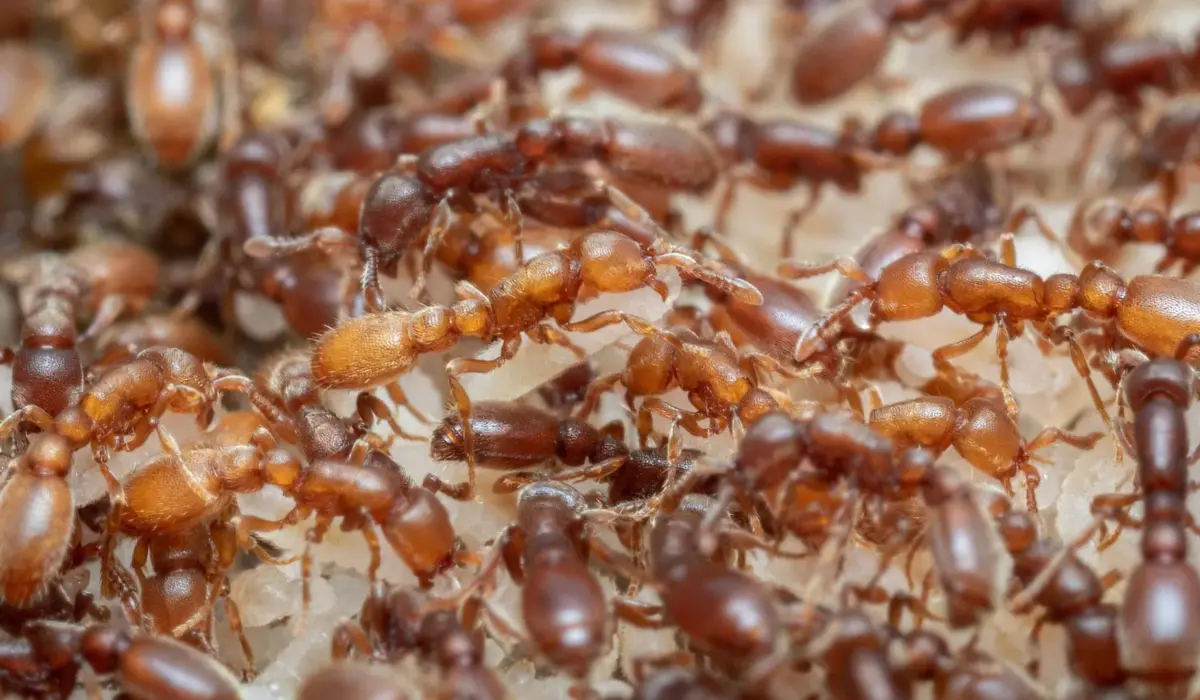
To circumvent these hurdles, the Rockefeller research team turned to clonal raider ants. These insects present an ideal middle ground. An individual ant brain contains approximately 60,000 cells, rendering it vastly simpler than a mammalian brain while still housing sophisticated social behaviors.
Crucially, clonal raider ants exhibit a natural, predictable behavioral transition tied to their age. Young ants remain securely inside the nest, dedicating their time to nursing and tending developing larvae. As they age, they transition outward, abandoning nursery duties to forage for food outside the nest. This strict, age-dependent division of labor provided researchers with a living laboratory to observe how brain chemistry drives shifts in social roles.
Automated Behavioral Tracking and Chemical Mapping
To quantify these dynamics, the research team engineered an automated behavioral monitoring system. By pairing individual ants with individual larvae, the system tracked hundreds of discrete caregiving interactions with unprecedented precision.
Simultaneously, the scientists mapped the ant’s neuropeptidome—the complete catalog of signaling molecules utilized by the brain. They successfully identified 70 distinct neuropeptides. Isolating and synthesizing these chemical messengers, the team tested each one individually to determine its impact on the ants’ propensity to nurture larvae.
Through this rigorous screening, two standout neuromodulators emerged as the primary drivers of the behavioral shift:
- Neuropeptide F (NPF): Acts as a powerful catalyst for caregiving, driving ants toward nursing behaviors.
- Allatostatin A (AstA): Exerts the opposite effect, prompting ants to abandon larvae and initiate foraging activities.
Young ants naturally displayed elevated levels of NPF and suppressed levels of AstA in critical brain regions, locking them into a caregiving state. Older ants exhibited the exact reverse biochemical profile, explaining their migration toward foraging duties. When researchers experimentally manipulated the activity levels of these molecules, the ants’ behaviors shifted in real time, proving that these peptides actively control the choice between nursing and foraging.
Supporting Context & Metrics: The Hunger-Parenting Connection
To test whether these caregiving circuits were truly rooted in ancient feeding mechanisms, the researchers subjected the ants to dietary stress.
By comparing well-fed ants with food-deprived counterparts, the team discovered a direct biochemical link between hunger and caregiving. Starved ants experienced a spike in Neuropeptide F (NPF) and a drop in Allatostatin A (AstA), causing them to behave identically to dedicated young caregivers. Once fed, the chemical balance reversed immediately, dampening their focus on the larvae and reawakening their drive to forage.
This reveals a profound evolutionary symmetry:
- The Ant Brain: ~60,000 neurons, allowing for rapid, high-resolution mapping of micro-circuits.
- Identified Neuropeptides: 70 distinct chemical messengers cataloged in the ant neuropeptidome.
- Core Regulators: NPF (promotes caregiving) and AstA (promotes foraging).
- The Mammalian Parallel: Similar neuropeptide families regulate both caloric intake and maternal/paternal behaviors in mice and humans, confirming deep evolutionary conservation.
"Parental behavior is a lot about feeding—not just yourself, but your offspring," notes Daniel Kronauer. Evolution did not invent a completely separate module to handle the immense energetic demands of raising young; instead, it scaled up and co-opted the machinery that already existed to secure and process nutrition.
Official Statements and Expert Perspectives
The implications of this study extend far beyond myrmecology (the study of ants), offering a sweeping reframing of evolutionary biology.
Dr. Daniel Kronauer, head of the Laboratory of Social Evolution and Behavior at Rockefeller University, emphasizes the parsimonious nature of evolutionary adaptation:
"Our work is a prime example of how evolution seldom invents things from scratch. Evolution takes what it has and works with that, sometimes in very surprising ways."
By demonstrating that parental care builds directly upon neural circuitry for feeding, the study provides a unifying framework for how complex social structures emerge across disparate phyla.
Dr. Kay, a key collaborator on the research, highlights the constraints and predictability uncovered by the mapping process:
"It amazes me that similar parenting behaviors have evolved so many times in so many distinct animal lineages. Our paper suggests that the evolutionary routes to these sorts of behaviors are far more constrained than we may have naively imagined. That’s very exciting, because it may eventually lead to a blueprint of how these complex social behaviors evolve."
Future Outlook: Implications for Brain Aging and Mammalian Neurology
With the foundational link between feeding circuits and caregiving established, the research team is charting an ambitious path forward.
Mapping Neural Circuits
The immediate next step involves identifying the precise neural pathways modulated by NPF and AstA. By mapping these circuits down to individual cellular interactions, scientists hope to decode how chemical signals translate into complex behavioral outputs. Because mammals utilize closely related neuropeptide systems during parenting, comparative mapping could soon yield a universal biological blueprint for caregiving across the animal kingdom.
Unlocking the Mysteries of Healthy Brain Aging
Beyond parenting, the clonal raider ant model offers an unprecedented window into the aging brain. Contemporary neuroscience is heavily weighted toward studying late-stage neurodegenerative pathologies, such as Alzheimer’s and Parkinson’s disease. Consequently, science knows remarkably little about the subtle, cumulative neurochemical shifts that occur within a healthy brain across a normal lifespan.
Because age-related behavioral transitions are vital to the survival of an ant colony, these insects provide a natural, highly accessible system for studying healthy neuro-aging. Kronauer and his colleagues suspect that the same neuromodulatory mechanisms dictating the shift from nurse to forager in ants may govern age-dependent behavioral changes in other species, including humans.
"There’s a lot of research and funding invested in studying late-stage neurodegenerative diseases, but we actually know very little about how the brain changes throughout the normal healthspan of an individual," Kronauer reflects. "In ant colonies, these dynamics are central to the organization of the society. Our discovery provides a striking demonstration that neuromodulators can produce age-dependent changes in behavioral proclivities in ants, and I suspect that that’s the case in other animals as well, including in humans."
As researchers continue to decode the biochemical levers of the ant brain, they are not only solving the evolutionary mystery of how caregiving began—they are illuminating the shared physiological threads that connect all social animals, from the smallest insect colony to human society itself.